
RESOURCES · COMPLIANCE
What the 2026 freelance compliance changes mean for hirers and freelancers
By Tom Pammenter · 13 November 2026
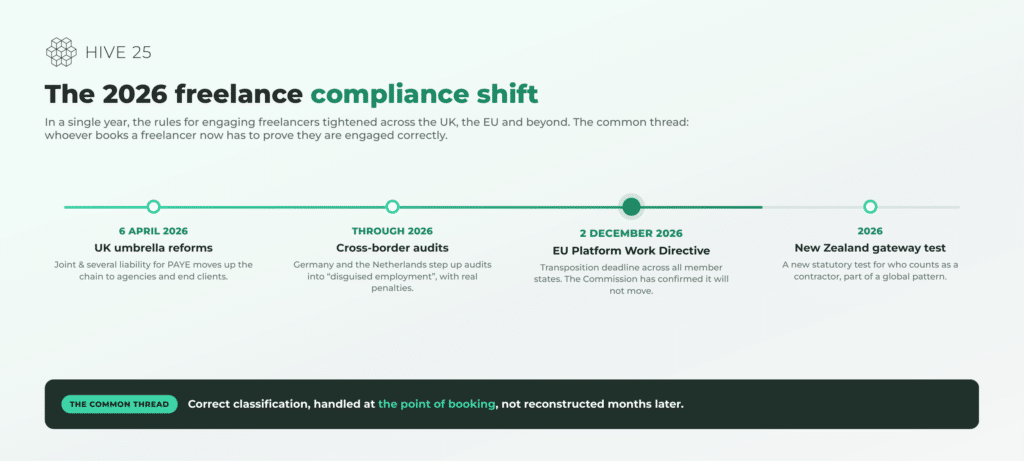
The way companies engage freelancers is changing faster than it has in years. New rules are landing across Europe, the UK and beyond, and most of them point in the same direction: whoever books a freelancer is now expected to prove that person is engaged correctly, not just assume it. This is a plain-English guide to what is changing in 2026 and what it means, whether you hire freelance crew or work as one.
Key takeaways
- From 2 December 2026, every EU member state must have the Platform Work Directive in national law, and the deadline will not move.
- The UK umbrella reforms from April 2026 push PAYE risk up the chain to agencies and end clients.
- Germany, the Netherlands and others are auditing disguised employment, with real penalties.
- The common thread is correct classification, and accountability sitting with whoever does the engaging.
- The teams that scale freelance talent will handle compliance at the point of booking, not after the fact.
What is changing in 2026
The EU Platform Work Directive (from 2 December 2026)
Every EU member state is required to have the Platform Work Directive written into national law by 2 December 2026, and the European Commission has confirmed the deadline will not be postponed. The directive is aimed at digital labour platforms, but it matters to everyone because of the principle behind it: a legal presumption of employment where the signs of control are present, and far more transparency about how work is allocated. Countries including Germany, Sweden and Italy have already moved, and each is implementing it slightly differently, so cross-border engagement now means keeping track of several regimes at once rather than one.
UK umbrella company reforms (from 6 April 2026)
Since 6 April 2026, responsibility for getting PAYE right on umbrella company payments is shared, on a joint and several basis, with the agency or end client in the supply chain. In practice this has made agencies and hirers far more selective about which umbrella companies they will work with, and much more interested in being able to see that the chain beneath them is compliant. IR35 itself has not changed, but the risk of getting the wider picture wrong now sits higher up the chain.
Tighter enforcement across borders
Beyond the headline legislation, enforcement is stepping up. Germany and the Netherlands have increased audits into “disguised employment”, with financial and in some cases criminal penalties attached. New Zealand is introducing a new contractor “gateway” test. The common thread everywhere is correct worker classification, and accountability shifting towards the organisation doing the engaging.
What it means if you hire freelancers
The short version: you carry more of the risk than you used to, and “we assumed they sorted their own status” is no longer a safe position.
- Classification and right to work are now your concern, not only the freelancer’s. You need to be able to show how each person is engaged and that they are cleared to work.
- If you use umbrella companies, expect to tighten your preferred supplier list and to want visibility of compliance further down the chain.
- Contracts, right-to-work checks and classification are best handled at the point you book someone, not reconstructed months later.
- If you engage crew in more than one country, you are now dealing with several regimes at once, each transposing the rules slightly differently.
- Record-keeping matters. If an audit comes, the question is whether you can evidence compliance quickly, for every booking.
What it means if you are a freelancer
For freelancers, the changes cut both ways. There is more scrutiny, but being visibly compliant is becoming a genuine advantage.
- Your working status will be looked at more closely, so keeping your right-to-work documents, company details and classification information current is worth the effort.
- If you work through an umbrella company, you may find hirers accept fewer of them, so check your arrangement is on solid ground.
- Clean, up-to-date compliance makes you easier to book. Hirers increasingly filter for crew who are already cleared to work.
- Getting paid correctly and on time depends on the paperwork being right at the start, not chased afterwards.
The common thread: compliance at the point of booking
Across all of these changes, the direction is the same. Compliance is moving from something handled after the work, by a separate team or a spreadsheet, to something that has to be part of booking someone in the first place. The organisations that will scale their use of freelance talent over the next few years are the ones treating right to work, classification, contracts and payment as part of the booking itself.
That is exactly what Hive 25 is built to do. Availability, booking, onboarding and compliance checks sit in one place, so you only ever book crew who are cleared to work, and the evidence is there if anyone asks. See how it works on our crew scheduling software page, or take the freelance compliance health-check.
FAQs
The directive specifically targets digital labour platforms, so it will not directly regulate every broadcast hirer. But it is the clearest signal yet of the direction of travel on worker classification, and that direction, backed by the UK umbrella reforms and rising audits, affects anyone who engages freelancers.
Review who is in your supply chain and make sure you can see that they are compliant, because since April 2026 the PAYE risk can land on the agency or end client, not just the umbrella.
Each EU member state is transposing the Platform Work Directive slightly differently, so you are now managing several sets of rules at once. A single system that records compliance consistently across every booking makes that far easier to stay on top of.
Compliance, handled at the point of booking
See how Hive 25 keeps availability, booking, onboarding and compliance in one place.
This guide is general information, not legal advice. For your specific situation, take professional advice.